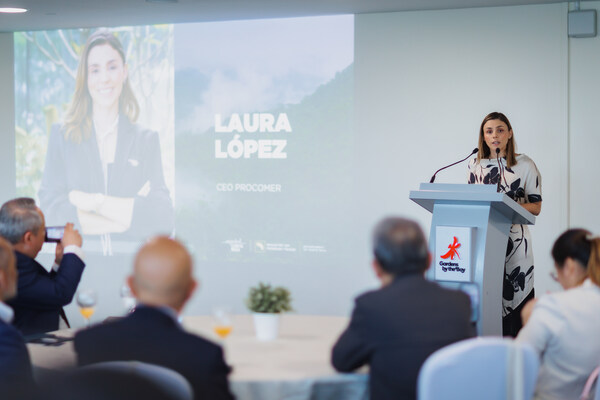
Laura López, CEO of PROCOMER, at the opening.
Costa Rica took a significant step in its Asia strategy on April 17, 2026, with the official opening of the Costa Rica´s PROCOMER, Investment Promotion Office in Singapore — its first such office in Southeast Asia and a move both sides see as a bridge between Latin America and one of the world’s most connected business hubs.
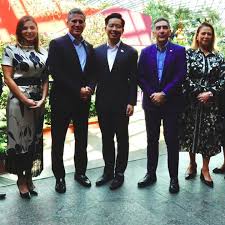
The inauguration, held at Gardens by the Bay, was attended by Costa Rica’s Minister of Foreign Trade Manuel Tovar Rivera and Singapore’s Minister of State for Trade and Industry Alvin Tan.
For Costa Rica, the new office is about far more than a physical presence. It is a signal that San Jose wants to deepen its footprint in Southeast Asia, diversify its export markets, attract new investment into high-value sectors and position itself as a credible long-term partner in an era of supply-chain shifts and geopolitical uncertainty.
The move also builds on the Singapore-Costa Rica Free Trade Agreement, which entered into force on July 1, 2013, and on broader efforts to integrate Costa Rica into new trade frameworks such as the Comprehensive and Progressive Agreement for Trans-Pacific Partnership and the Digital Economy Partnership Agreement, where Singapore has emerged as an important partner.
Speaking at the opening, Mr Tovar framed the moment as the launch of a much larger relationship.
“Today, we’re not just opening an office, we’re opening a bridge,” he said. “Singapore represents global connectivity, precision and forward-looking investment, and by establishing a presence here, Costa Rica is sending a clear message: we are ready to engage, ready to collaborate and ready to grow together.”
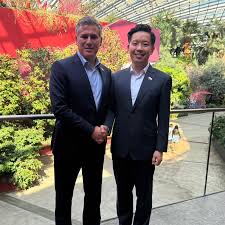
Costa Rica’s Minister of Foreign Trade Manuel Tovar Rivera and Singapore’s Minister of State for Trade and Industry Alvin Tan
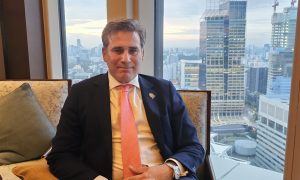
In an exclusive interview with Inside Recent afterwards, Mr Tovar said the timing was deliberate. Costa Rica, he said, is a trading nation by necessity and by design, with roughly three-quarters of its gross domestic product linked directly to trade and global supply chains. In a world where protectionism and strategic fragmentation are rising, he argued, the answer for countries like Costa Rica and Singapore is not retreat, but deeper engagement.
That logic helps explain why Singapore was chosen. Mr Tovar described the Republic as both a destination and a regional platform — a place where Costa Rica can build awareness, connect with investors, and use Singapore’s gateway role to engage wider Southeast Asia. He said the opening should have happened earlier, calling it “long overdue”, but insisted it now comes at an opportune moment as Costa Rica pushes to widen its commercial map beyond traditional North American markets.
That push is backed by real numbers. Mr Tovar said Costa Rica’s exports grew 11 per cent last year, while exports to Asia rose 39 per cent, making the region its fastest-growing market. More important than the top-line growth, he argued, is the change in what Costa Rica now sells to the world.
Medical devices now account for more than 30 per cent of Costa Rica’s export basket, followed by business services and digital technologies, reflecting what Rivera called a decisive shift from a commodity-based economy to a knowledge-driven one.
PROCOMER’s own investment platform describes life sciences and medtech as pillars of Costa Rica’s modern export model, while semiconductors, advanced manufacturing and technology services are increasingly central to its next phase of growth.
“Costa Rica is much more than what many people still focus on,” Mr Tovar said. “Yes, we are world-class exporters of pineapple and bananas. But very few people know that our main export products are advanced manufacturing processes, medical devices and semiconductors.”
That message was also central to Mr Tan’s remarks at the launch. He said Singapore and Costa Rica share striking similarities: both are relatively small, trade-dependent nations that have had to leverage strategic geography, political stability, talent and openness to thrive.
“Singapore and Costa Rica have much in common,” Mr Tan said in comments posted after the event. “We are small trade dependent nations with a deep commitment to a rules-based multilateral trading system.” He noted that Costa Rica, like Singapore, has a strategic location and an economy increasingly shaped by high-tech manufacturing, medical supplies and the green economy.
In his speech, Mr Tan developed that point further, speaking of “nature and nurture”. Both countries, he said, had been endowed by geography with strong locations — Costa Rica as a bridge to Central and Latin America, Singapore at the crossroads of Southeast Asia and major global shipping lanes. But geography alone is not enough, he argued. Political stability, rule of law, a pro-business mindset and investment in talent are what allow countries to convert location into lasting economic advantage.
Mr Tan also placed the PROCOMER opening within a wider policy context. Singapore and Costa Rica, he said, have been working together on multiple fronts, from WTO reform to digital trade and new-generation trade architecture. Singapore’s Ministry of Trade and Industry has said discussions for Costa Rica’s accession to DEPA substantially concluded in January 2025, while Costa Rica has also been pressing ahead with CPTPP accession talks.
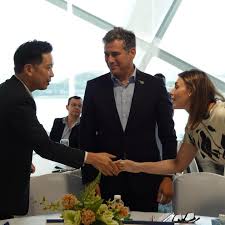 For Mr Tovar, these frameworks matter because they connect Costa Rica not just to Singapore but to a broader coalition of economies still willing to defend open trade. He repeatedly returned to that theme, describing Singapore as a country Costa Rica “looks into the mirror” to learn from. He praised Singapore’s leadership in initiatives such as DEPA and the Future of Investment and Trade Partnership, arguing that smaller countries have the greatest stake in preserving a rules-based system because they have the most to lose if global commerce becomes a contest governed solely by power.
“Small countries like ours will be the orphans of the erosion of the rules-based system,” he said in the interview. “So we must continue preaching and advocating for multilateral solutions, but also finding pragmatic ways to do business.”
That pragmatism shapes the new office’s investment pitch. Mr Tovar said Costa Rica is not trying to compete head-on with Asia’s large-scale industrial producers. Instead, it wants to complement them, especially in segments of strategic supply chains that demand design, engineering, R&D, validation, testing and high-value services.
He pointed in particular to semiconductors, where Costa Rica has built a 35-year ecosystem, anchored by players such as Intel and Applied Materials, even if Singapore’s own history in the sector is almost twice as long. PROCOMER’s investment site highlights semiconductors as a national priority and notes the presence of Intel, Qorvo, Zollner and Teradyne in the country’s ecosystem.
“We’re not here to compete. We’re here to complement,” Mr Tovar said. “Every country has its strengths. What we are targeting is more knowledge-intensive activity. The massive wafer fabrication may happen elsewhere, but there is room for design, engineering and services, and that is where Costa Rica can contribute.”
A big part of that pitch rests on talent. Mr Tovar said Costa Rica has adjusted academic curricula, expanded university training and introduced grants that can finance up to 90 per cent of skilling, reskilling and upskilling for companies operating in the country. The government has also eased migration rules for specialised talent from abroad, with the expectation that incoming experts help train local workers as well.
That talent focus is one reason why Costa Rica has remained attractive despite global investment headwinds. Rivera said the country attracted more than US$5 billion in foreign direct investment last year, while reinvestment rose 26 per cent to a historic high. PROCOMER recently said Costa Rica surpassed US$5 billion in FDI inflows for a second consecutive year, underlining its appeal as a stable and credible nearshoring base.
The minister said that message is especially relevant now, when multinational firms are reassessing geography, resilience and risk. Costa Rica’s argument, he said, is straightforward: it offers stability, legal certainty, democratic continuity, free-zone incentives, global market access and a business ecosystem where companies not only arrive but stay and expand.
 He also stressed that the new Singapore office is meant to support firms through the full investment journey. “You will not navigate Costa Rica alone,” he said. “We are long-term allies.”
Still, Mr Tovar was candid that the global backdrop is difficult. He said Costa Rica has been partially shielded from the worst of current energy disruptions because almost all its electricity comes from renewables and most of its oil and gas imports come from the United States rather than the Gulf. But he warned that the indirect effects of war, inflation, logistics costs and weaker demand in partner economies could still hurt tourism, manufacturing inputs and export appetite.
For that reason, he said, Costa Rica’s best protection lies in the same thing that brought PROCOMER to Singapore: diversification.
“We are no longer dependent on a single market,” he said. “In a world where companies are looking for reliability and flexibility, diversification is not just strategy. It is competitive advantage.”