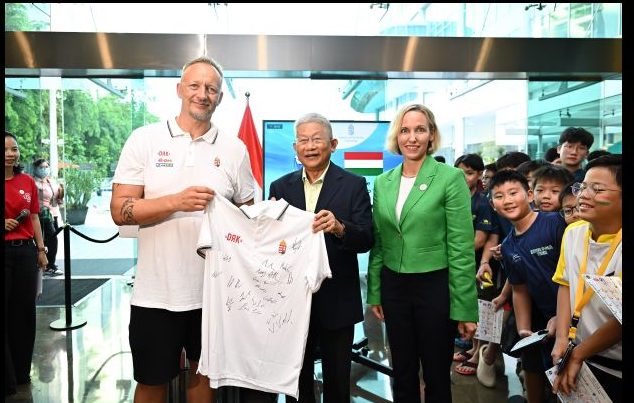
SINGAPORE, 10 July 2025: Under the gleaming lights of the Chinese Swimming Club, one of Singapore’s most storied aquatic institutions, the Embassy of Hungary brought together history, culture and athletic excellence in a stirring Meet-and-Greet with the Hungarian Men’s Water Polo Team.
This landmark event, held in the lead-up to the World Aquatics Championships – Singapore 2025, drew close to 120 guests including diplomats, youth athletes, media professionals and members of the Hungarian expatriate community.
The stars of the evening were indisputably the Hungarian team themselves, nine-time Olympic champions and widely regarded as the greatest water polo team in the world.
With 16 Olympic medals, four World Championship titles and 13 European Championship victories, Hungary’s water polo legacy is unmatched. But, beyond their accolades, it was their warmth, accessibility and humility that captivated the young Singaporean athletes in attendance.
“I am very happy that we could bring the Hungarian men’s water polo team, part of one of the most successful water polo traditions in the world, to the Chinese Swimming Club, a true cornerstone of Singapore’s aquatic sports,” said H.E. Judit Pach, Ambassador of Hungary to Singapore. “This encounter is a strong symbol of how close our nations are, and how sports can deepen people-to-people connections and strengthen our relations in meaningful new ways.”
The evening’s programme was more than just ceremonial. A live operatic performance by Hungarian baritone Levente Molnár added a touch of cultural elegance, while an engaging 13-piece sports photography exhibition by István Derencsényi showcased powerful moments in aquatic sports.
Derencsényi, who has been covering water polo for decades and has been the official photographer for the World Aquatics Championships since 2017, shared stories behind some of his most iconic images.
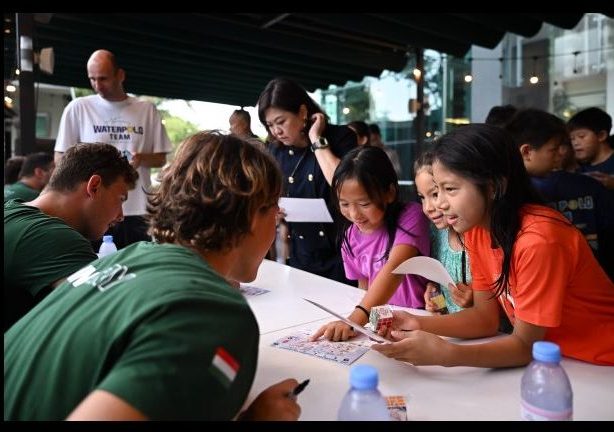
One particularly poignant moment came as the Hungarian team interacted with local youth athletes from the Chinese Swimming Club. Aspiring players peppered the champions with questions about training discipline, diet and how to stay motivated. In return, they received enthusiastic encouragement and heartfelt advice.
“This event was both inspiring and nostalgic to me,” said Mr Lee Kai Yang, captain of the Singapore National Men’s Water Polo Team. “Back in 2008 and 2011, the Hungarian National Team also came to Singapore to prepare for major championships. I was just a young player in love with the sport, watching them from afar. Today, I got to stand beside them. It’s truly a full circle moment.”
Hungarian Head Coach Zsolt Varga was equally moved by the warm reception. “What’s especially gratifying for us is that, alongside the many enthusiastic Singaporean water polo players, a large number of members from the local Hungarian community also turned out to show their support. Their presence has given our team a real boost during this important period. We hope to bring just as much joy over the next two weeks as the warm welcome we received yesterday.”
Mr Victor Chia, President of the Chinese Swimming Club, added: “At the Chinese Swimming Club, water polo has long been a part of the club’s sporting identity. Today, thanks to the Hungarian team, we have a solid, strong source of inspiration for our athletes.”
Also present were Ms Diana Pang, Member of Parliament for Marine Parade-Braddell Heights GRC, and Mr Mark Chay, Secretary-General of the Singapore National Olympic Council. Mr Chay noted: “For sports like water polo, which are very Europe-centric, we don’t often get to see the top teams up close. Hopefully, their presence will inspire the next generation and show them what the world standard looks like.”

 But what makes Hungary so dominant in water polo? The answer lies in a unique combination of culture, history, innovation and government support.
Water polo is more than a sport in Hungary — it is a national passion. An abundance of thermal springs allowed year-round training in warm water, giving Hungarian athletes an edge in developing technique and endurance.
Coach Dénes Kemény, who led Hungary to three consecutive Olympic golds from 2000 to 2008, once said: “If you can stay in the pool longer when the water is warm, your fundamentals, movements and coordination improve significantly.”
Hungary was also an early innovator. In 1913, inspired by a circus act involving wrist-flicking plate catches, Hungarian players adapted the technique to create more dynamic passes and shots. Their dominance began in earnest with an Olympic gold in 1932, and between 1928 and 1939, Hungary won 110 straight international matches.
The team’s legendary toughness was on display in the infamous “Blood in the Water” match during the 1956 Melbourne Olympics, shortly after the Soviet invasion of Hungary. That game against the USSR became a symbol of national pride and defiance.
Photographer Derencsényi, who has documented the team extensively, said: “This is more than a team — it’s a family. There’s an intimacy, an authenticity to the way they carry themselves. You feel connected.”
Today, the sport in Hungary continues to thrive thanks to substantial government investment. A 2011 tax incentive programme has funnelled over US$270 million into infrastructure, youth training and development. The country now boasts some of the best aquatic facilities in Europe, and water polo remains a prestigious pursuit.
As Ambassador Pach explained: “This is a sport for the smart guys.” The intellectual rigour and strategic gameplay of water polo are held in high regard, and generations of Hungarian athletes have passed down their knowledge, ensuring continuity and excellence.
With over 350 Hungarians living in Singapore, many turned up at the event, forming a vocal and passionate cheering section. Their support not only buoyed the team’s spirits but added a familial atmosphere to the evening.
Singapore, too, stands to gain. As Hungary prepares to compete in the World Aquatics Championships – Singapore 2025, discussions are already underway for broader collaboration, including coaching exchanges and athlete development.
Ambassador Pach confirmed: “We already have Hungarian coaches working with the Singapore Canoe Association and fencers coming here for training. With this visit, perhaps we can build similar partnerships in water polo.”
 As the Hungarian team continues their acclimatisation and preparations, and Singapore gears up to host the World Aquatics Championships, one thing is certain — this meet-and-greet was more than a photo opportunity. It was a celebration of excellence, heritage and the power of sport to unite.
And as the chants of “Hajrá Magyarok!” (Go Hungarians!) echoed through the hall of the Chinese Swimming Club, the stage was set for a summer of world-class competition — and deeper connections between two nations brought together by the water.